You bring the domain. We bring the AI factory.
A domain expert with a real problem, and a repeatable machine that turns it into a company — a control plane that runs the build, a team that operates it, and a technology stack every venture inherits on day one.
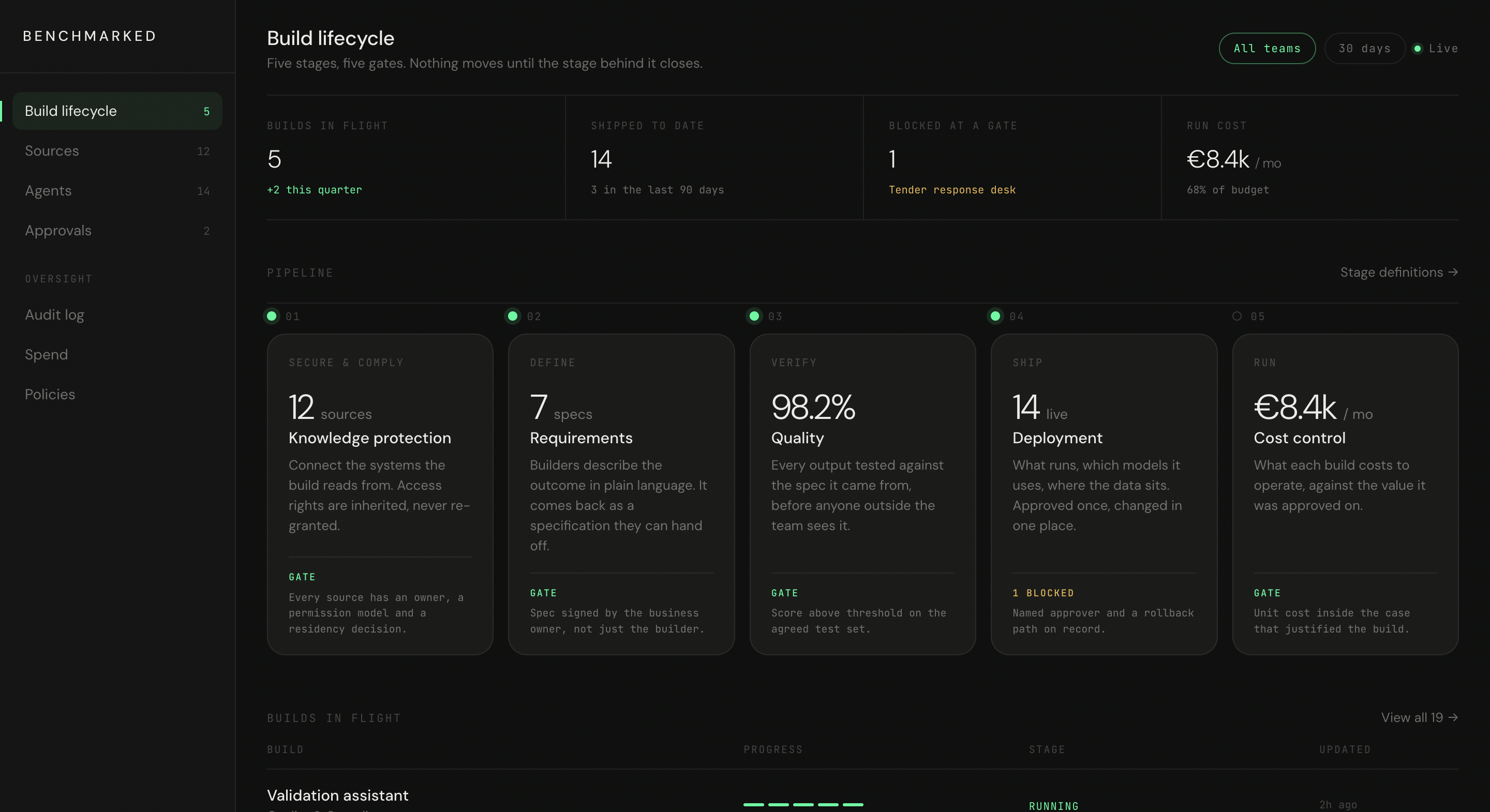
From domain expertise to production. With receipts.
You describe the business in plain language. The factory turns it into specs, agents, code and tests — and leaves a trail you can audit at every step.
Living documentation
A knowledge graph of the venture that never drifts from what is actually running.
Full visibility
Every decision, change and rationale is recorded — including the ones an agent made.
Humans in the loop
Your experts co-author specs and approve gates. The AI proposes; the operator decides.
Context flows both ways
Feedback from production loops back into requirements instead of dying in a ticket.
Model and IDE of choice
No lock-in to a frontier lab. Swap models — including local ones — without losing context.
Greenfield and legacy
New ventures from zero, or an existing operation modernised system by system.
Every build runs through the same five gates.
Builders always know the next step; leaders always know where every build stands. Nothing moves forward until the stage behind it closes.
Key SDLC modules
The control plane is assembled from these modules. Every venture gets all of them on day one — and owns them when we hand over.
Knowledge protection
Your domain know-how, data and prompts stay inside your boundary — encrypted, access-controlled and never used to train anyone else's model. The venture's alpha is treated as the asset it is.
Requirements
Fast code is useless without clear direction. Domain experts and agents co-author, debate and refine requirements in one workspace, in language the business can actually read.
Quality
Every feature is validated against the requirement that created it. Tests, reviews and evals run before anything ships, so correctness is proven rather than promised.
Deployment
One path to production across environments — your cloud, your on-prem, or a sovereign EU region. Releases are reproducible and reversible, with no hidden vendor runtime.
Work order
Product intent and architecture become structured work orders with the full context an agent needs to generate correct, aligned code — and a human owner for every one.
Cost control
Token, compute and infrastructure spend metered per venture, per agent, per model. Swap to cheaper or local models when the work allows and watch unit economics flatten.
Loops
Feedback from production, support and operations comes back in as structured work instead of dying in a ticket. The system learns from what actually happened.
If you don’t want to do this alone, this is the team we bring in to execute your vision.
Extremely lean by design — the same people who design the venture also build and ship it, embedded with your team rather than billing from a bench.
The people who run the ventures.
“We came in with twenty years of domain knowledge and no engineering team. Ten weeks later we were running our own software — not renting someone else's.”
“The audit trail is what got it past our risk committee. Every agent action has an owner, a rationale and a timestamp.”
“Our per-user cost stopped climbing the month we moved the model layer in-house. That single change made the unit economics work.”
“It replaced a six-month spec phase with a week of structured argument. The specs are better because everyone could actually read them.”
Every venture inherits the same stack.
Six layers, built once, reused across every company the factory produces.